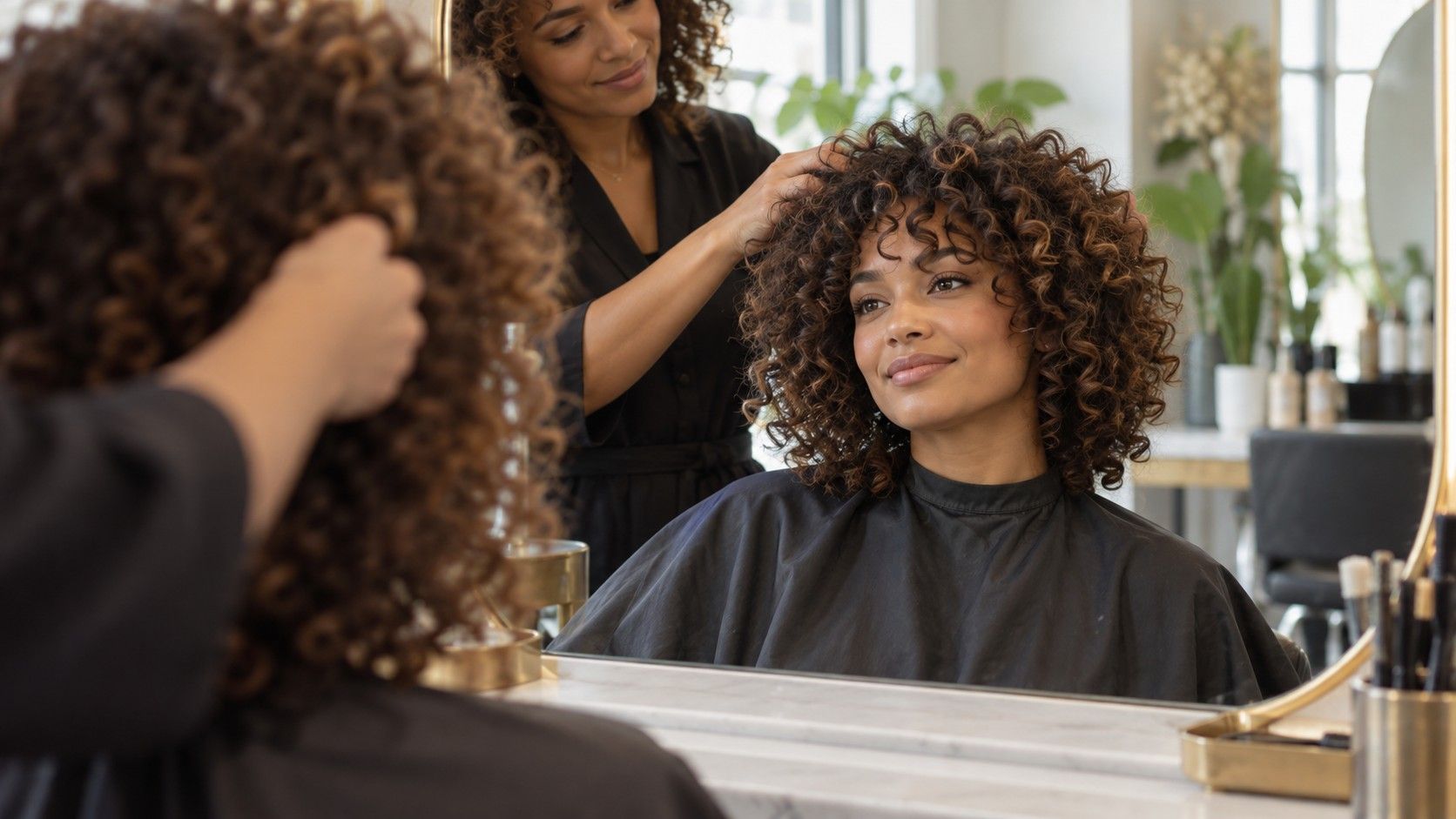
Curly haircuts are often judged in the first five minutes after a salon finish, which is not much use when the real test happens after sleeping on it, walking through damp air, and trying to refresh it before work. A good curly cut leaves room for the pattern you already have. It does not ask every curl to behave like the curl beside it, and it should still make sense when the diffuser stays in the drawer.
Start with the curls you really live with
Most heads have more than one curl pattern. The front may form loose spirals, the nape may be tighter, and a patch near the crown may go almost straight when it is weighed down. That is normal. Choosing hairstyles for curly hair from a single label can be misleading because a cut reacts to density, shrinkage, porosity, and the way the hair changes between wash days.
Why the cutting method changes the result
Look at your hair on a normal day, not only after a perfect wash routine. Where does it expand? Which pieces lose definition first? Does the top flatten while the sides get wider? A few phone photos taken in the same daylight across several days are more useful than one dramatic reference image. They show a stylist the pattern that needs to be cut, including the awkward bits that product ads politely ignore.
Choose the length around shrinkage, not the ruler
A dry cut can be helpful when the stylist knows curly hair well because each curl is trimmed where it naturally lands. It makes shrinkage visible in the chair. That does not make dry cutting the only legitimate method. A wet cut can work beautifully when the hair is sectioned with its pattern in mind and the shape is checked again dry. The useful question is not which method sounds more specialised. It is whether the stylist plans to assess the haircut after the curls return to their usual size.
Ask what happens if one section springs up more than expected. A careful stylist will talk about gradual adjustment, not one aggressive first pass. Curls can look uneven while damp and settle into balance after they dry. Taking too much off to make wet hair appear symmetrical is a common way to end up with a crown that looks much shorter than intended. Haircuts for curly hair need patience at this stage, especially around the face.
The length you see in a photo can be a poor prediction of the length you will wear. A curl that reaches the collarbone when stretched may sit well above the shoulder once it dries. Before a cut, pick a point on your own body that you do not want the hair to rise above, then discuss it while the hair is in its natural state. This is more practical than asking for two inches off, because two inches behaves differently on a loose wave and a tight coil.
Short curly shapes can look lively and low effort, but they are not always low maintenance. A rounded crop needs regular reshaping if you want it to stay rounded. A chin-length curly bob often gives enough weight to calm the sides while keeping the neck clear. Longer curly hair can be easier to tie back, though it may pull flat at the roots. There is a trade-off, and pretending otherwise is how people leave a salon pleased with a photo but unsure what to do the next morning.
| Length choice | What it can solve | Check before committing |
|---|---|---|
| Short rounded crop | Shows the curl pattern and reduces drying time | How high the crown will spring after washing |
| Chin to shoulder bob | Keeps a visible outline and can balance wide sides | Whether the jaw area expands in humid weather |
| Layered shoulder cut | Gives curls room to stack instead of forming a triangle | Where the shortest layer lands around the face |
| Long layered cut | Offers weight and easy tie-back options | Whether the roots go flat under the length |
Layers need a reason and a place to land
Layers can make curly hair feel lighter, but a random cascade of short pieces can turn one head into several competing shapes. The useful kind of layer removes a bulky shelf, gives the crown more lift, or stops the lower lengths from swallowing the face. It should be possible to point to the part of the head it is meant to improve. If the answer is simply that curls need layers, keep asking.
A curly shag can be great for medium to dense hair with a clear wave or curl pattern. It gives the hair a more relaxed outline and lets sections fall separately. It can also expand dramatically if the upper layers are too short or the humidity is high. For a quieter result, longer layers beginning around the cheekbones or below often preserve the curl clumps while avoiding the wide triangular silhouette that many people are trying to escape.
Curly bangs are a daily choice, not a tiny add-on
Bangs can bring the eyes forward and make a long curly cut look less heavy, but they are the one section you will see every morning. That deserves more thought than a quick snip at the end of an appointment. Curly fringe usually sits shorter and wider as it dries, and the pieces at the center can behave differently from the ones near the temples. Start longer than you think you need. You can always trim again once the curls settle.
Consider your refresh routine too. If you already mist and reshape the front sections every morning, bangs may fit naturally into it. If you prefer to tie your hair up and leave the front alone between washes, a full fringe may become the part you resent. A few face-framing curls can give a similar effect with less commitment. They also grow out more gently if you change your mind halfway through the season.
Build a wash day that protects the haircut's shape
The routine should support the cut rather than compete with it. Detangle when the hair has plenty of slip, then apply your chosen styling product in sections that match how the hair naturally groups together. Curl clumps are not a trend word; they are simply the small groups of strands that dry in the same direction. Breaking them apart too early with a brush often creates the fluffy surface people then try to fix with more product.
A diffuser is useful when you want faster drying and a little lift at the root, but it is not mandatory. Keep the heat moderate, avoid moving the hair around constantly, and stop before it is baked dry. If you air-dry, resist touching it every few minutes to see whether it is working. That habit creates frizz faster than most weather forecasts. Once the hair is fully dry, loosen any firm product cast with clean hands and judge the shape then.
Refresh for the next day without starting over
Curly hair styles rarely look identical on day two, and they do not need to. A full reset every morning is tiring and can leave the hair perpetually wet or overloaded. Start by looking at the sections that are actually misshapen. A little water on the front, a small amount of leave-in on dry ends, and a quick finger twist on one flattened curl may be enough. Leave the parts that still look good alone.
Humidity will still change the result. In damp weather, choose a style that has room to expand rather than fighting for a razor-sharp outline. A loose half-up style, a low bun with a few curls left out, or simply a softer part can make the shift look intentional. The best curly haircut is not the one that promises perfect control. It is the one that lets you recognise your own hair on an ordinary day and gives you a few workable choices when it does something different.